Beauty of Joseon Relief Sun Review: The Sunscreen Everyone's Already Using
It's arguably the most-hyped sunscreen in K-beauty right now, and it comes with a genuinely confusing label discrepancy between the US and Korean versions. Here's what's actually in it, and how it compares to the other sunscreen on this site.
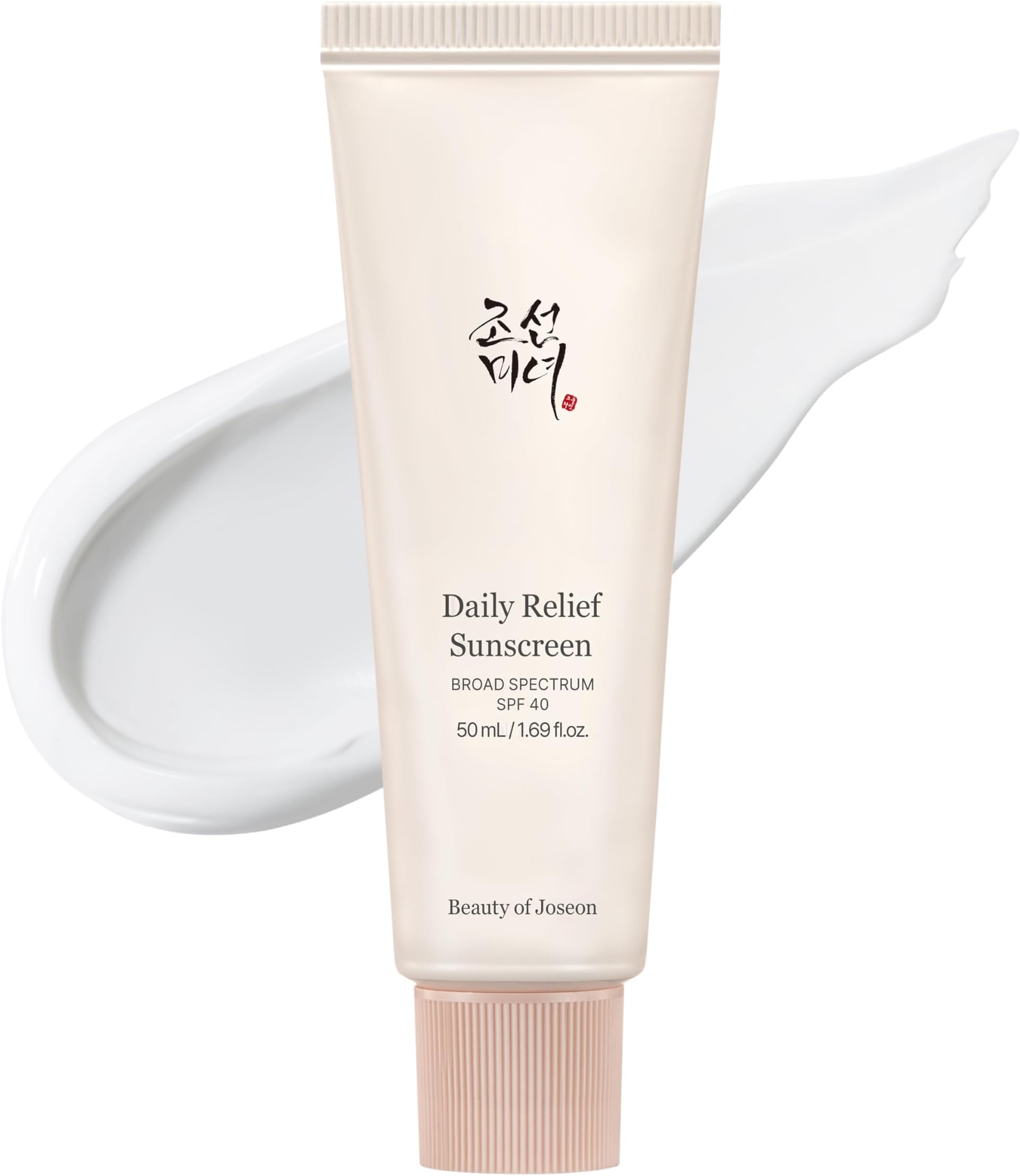
If you've spent any time in a skincare corner of the internet in the last few years, you've seen this bottle. Beauty of Joseon's Relief Sun is the sunscreen that broke out of K-beauty circles entirely and started showing up in mainstream "best sunscreens" roundups — and unlike a lot of viral products, the reason isn't just the packaging (though the hanbok-print label doesn't hurt).
What's actually in it — and a labeling quirk worth knowing
The formula leans on rice extract and a fermented rice-based "probiotic" complex as its hydrating base, which is the "Rice + Probiotics" half of the name. Treat those as the moisturizing vehicle, not proven anti-aging actives — a general dermatology review of rice products covers traditional and cosmetic use, and a more recent animal study on fermented rice bran extract found increased collagen and elastin synthesis in mouse skin, but neither is the kind of large human trial that would let us call the rice-and-ferment angle "clinically proven" for your face. The reason to actually buy this product is the SPF.
Here's the part worth flagging: in Korea, this sunscreen is sold and labeled SPF 50+ PA++++. The version sold on Amazon in the US is labeled Broad Spectrum SPF 40. Beauty of Joseon and independent reviewers who've compared the two markets describe it as the same formula, with the difference coming down to regional testing and labeling rules — in the US, sunscreen is regulated as an over-the-counter drug and tested against FDA's own protocol, while Korea rates SPF/PA separately and doesn't require FDA-style monograph testing. It's not a sign of a weaker or different product; it's a paperwork difference between two regulatory systems. Still, if you've seen "SPF 50+" referenced online and then see "SPF 40" on the bottle you actually receive, that's why — and daily broad-spectrum sunscreen use itself has solid randomized-trial evidence behind it for preventing photoaging, whichever number is on the label.
Texture and finish
This is the part that actually explains the hype: it's a thin, almost watery lotion that spreads in seconds, sets down to a soft matte-adjacent finish, and doesn't leave the grey or purple cast that mineral sunscreens are known for. It layers cleanly under makeup and doesn't pill when you add a moisturizer or serum underneath it, which is the difference between a sunscreen you reapply and one that lives in the back of a drawer after week one.
Who it's genuinely good for
- Combination to oily skin that wants a lightweight, fast-absorbing daily SPF without a heavy or greasy after-feel
- Anyone who's given up on sunscreen because every option they've tried left a visible cast — this is one of the more reliably cast-free formulas at this price
- People who want a lot of product for the price — a little goes a long way and the 50ml bottle lasts
Who might want something else
- Very dry skin in a cold or low-humidity climate may still want a richer moisturizer layered underneath, since this is a thin, fluid formula rather than a cream
- If a mineral (zinc oxide) filter matters to you specifically, this is a chemical-filter formula — patch test if you're chemical-filter sensitive
- If the exact SPF number on the label matters for your situation, know you're getting the FDA-tested SPF 40 US version, not the SPF 50+ PA++++ version sold in Korea
How it compares to the other sunscreen on this site
Beauty of Joseon and Round Lab's Birch Juice Sun Serum solve the same basic problem — a cast-free daily SPF — from slightly different angles. Round Lab leans into its "sensitive skin, minimal ingredient" brand identity, with a serum-thin texture built around birch sap and PDRN. Beauty of Joseon is the more mainstream, mass-market pick: cheaper, easier to find, and the one more likely to already be in a friend's medicine cabinet. If you want the minimalist, sensitive-skin-first formula, pick Round Lab; if you want the widely-loved, budget-friendly default, this is it.
Where it fits in the routine
Sunscreen is the final step of a morning routine — step 10 in the full 10-step routine breakdown, applied after moisturizer and before makeup. Use roughly a nickel-sized amount for the face and reapply if you're outside for extended periods, regardless of which SPF number is on the bottle.
Bottom line: the hype here is unusually well-earned — it's genuinely one of the more comfortable, cast-free daily sunscreens available, the US/Korea SPF number discrepancy is a labeling technicality rather than a formula downgrade, and at this price there's very little reason not to actually wear it every day.
References
Peer-reviewed sources for the ingredient claims above, retrieved via literature search. Cite the linked DOI when reusing any of this.
- Sunscreen and prevention of skin aging: a randomized trial — Ann Intern Med, 2013 — RCT
- Reduced melanoma after regular sunscreen use: randomized trial follow-up — J Clin Oncol, 2011 — RCT follow-up
- Dermatological uses of rice products: trend or true? — J Cosmet Dermatol, 2022 — review
- Fermented rice bran extract delays skin aging by increasing the synthesis of collagen and elastin — Front Pharmacol, 2025 — animal study
Keep reading
Dr.Jart+ Cicapair Color Correcting Treatment Review: Does the Green Cream Actually Work?
A cult K-beauty product that isn't a serum, a sunscreen, or a BB cream — it's all three, wrapped around one gimmick: a green tint that's supposed to neutralize redness as it dries down to beige. Here's what's actually backed by evidence and what's just color theory.
Laneige Water Sleeping Mask Review: The Face Version of Their Most Famous Product
We've already covered the Lip Sleeping Mask that made Laneige a household name. This is the original, face-sized version it was actually spun off from — here's what the overnight gel does that a regular moisturizer doesn't.
Anua Peach 70% Niacinamide Serum Review: The Niacinamide Is Doing More Than the Peach Is
This one went viral on the strength of its name and its scent. Underneath the peach marketing is a genuinely well-evidenced niacinamide serum — here's which half of the formula is actually earning the hype.

MISSHA M Perfect Cover BB Cream Review: The BB Cream That Started the Category
31,000+ ratings and counting — this is the product most credited with bringing 'BB cream' into English-language beauty vocabulary in the first place. Here's whether the original still holds up next to a decade of imitators.